Mold Remediation in Beaverton, OR — AMRT-Certified Crawl Space, Attic & Structural Mold Removal
Source-Corrected Mold Remediation That Doesn't Come Back — Serving Beaverton, Washington County & the Portland Metro Since 2015
If you've discovered mold in your Beaverton crawl space, attic, or walls, Tuala Beaver Restoration provides professional mold remediation in Beaverton, Oregon with IICRC AMRT-certified technicians following the ANSI/IICRC S520 Standard. In Beaverton's Pacific Northwest climate, any water damage not professionally addressed within 24 hours should be assumed to involve mold development — the ambient humidity does not allow materials to dry on their own within the mold-growth window. Our team identifies the moisture source, establishes negative-pressure containment, removes affected materials, and verifies clearance so mold doesn't return to the same location.
- Local Beaverton, OR mold remediation company since 2015
- IICRC AMRT (Applied Microbial Remediation Technician) certified on staff
- Follows ANSI/IICRC S520 Standard for Mold Remediation on every project
- AMRT plus CDS certification for commercial mold remediation scope
- Serving Aloha, Cedar Hills, Hillsboro, Tigard, Tualatin, and all of Washington County
No obligation. Free on-site mold assessment.
Request Your Free Mold Assessment
Fill out the form and we'll contact you immediately!
Mold Remediation for Properties Near Beaverton's Neighborhoods, Parks & Commercial Corridors
From Cedar Hills and Highland older homes to Sexton Mountain, Tualatin Hills, and the Five Oaks corridor
Tuala Beaver Restoration provides mold remediation throughout Beaverton, Oregon — from older Cedar Hills and Raleigh West homes built around 1986 with aging vapor barriers, inadequate crawl space ventilation, and original plumbing that presents higher mold risk than newer builds, to Sexton Mountain and Murrayhill newer developments where slab-on-grade construction creates different moisture accumulation patterns, to commercial properties near Nike World Headquarters, Progress Ridge TownSquare, and the Five Oaks and Tanasbourne commercial corridors. Beaverton's combination of long rainy seasons, naturally high humidity, and clay soils that retain moisture against foundations creates year-round mold risk that the region's restoration professionals consistently identify as among the highest in the Pacific Northwest. If your mold developed from a water event, we also provide emergency water damage restoration if mold developed from a water event.
Beaverton Neighborhoods
- Central Beaverton
- Denney Whitford / Raleigh West
- Five Oaks / Triple Creek
- Greenway
- Highland
- Neighbors Southwest
- Sexton Mountain
- South Beaverton
- Vose
- West Beaverton
- West Slope
Older Higher-Risk Areas
- Cedar Hills — 1986-era homes
- Raleigh Hills — aging vapor barriers
- Highland — older ventilation systems
- Vose — original plumbing risk
Commercial Corridors
- Nike World Headquarters
- Progress Ridge TownSquare
- Five Oaks corridor
- Tanasbourne commercial district
Nearby Service Areas
Parks adjacent to moisture risk: Tualatin Hills Nature Park, Fanno Creek Trail, Cooper Mountain Nature Park — properties near these greenways face elevated groundwater moisture risk contributing to crawl space and foundation mold.
Beaverton's AMRT-Certified Mold Remediation Team — Source Correction First, Commercial Capability Included
Removing mold without correcting the moisture source is a temporary measure in any climate — in Beaverton's, it's almost certain to fail
In Beaverton's climate, where outdoor humidity provides no drying assistance and crawl spaces may take on water repeatedly before the rainy season ends, mold removed without addressing the moisture driver will return quickly and often more extensively than the original outbreak. Our AMRT-certified technicians identify the specific moisture source — failed vapor barrier, inadequate crawl space ventilation, roof leak, or aging plumbing — before applying ANSI/IICRC S520-compliant remediation that includes proper containment, material removal, HEPA air treatment, and post-remediation clearance verification. If structural materials need replacement after mold removal, our team provides water damage repair if structural materials need replacement after mold removal.
When Do Beaverton Homeowners Need Mold Remediation?
Beaverton's climate means any unaddressed moisture event should be assumed to involve mold
In Beaverton's Pacific Northwest environment, the ambient outdoor humidity does not help structures dry naturally within the 24–48 hour mold-growth window. This is a documented local fact: restoration professionals in the Beaverton market consistently state that any water damage not professionally addressed within 24 hours should be assumed to involve mold development. Unlike drier climates where minor water events might self-correct, Beaverton's marine-zone humidity means that moisture trapped in walls, subfloors, or crawl spaces will sustain mold colonization regardless of whether the source water is removed. For immediate water extraction and drying, see our emergency water damage restoration services.
A musty odor in your home, particularly after Oregon's rainy season or following a water event
Visible dark patches — black, green, or white — on walls, ceilings, bathroom tile, crawl space framing, or basement surfaces
Respiratory symptoms, increased allergies, or headaches that improve when you leave the home
A home inspection or real estate transaction requiring mold clearance documentation
A water event in your home was not professionally dried within 24 hours
Your crawl space took on water during the Oregon rainy season and hasn't been assessed
Who Our Mold Remediation Service Is For
Homeowners, landlords, buyers, sellers, and commercial property managers throughout Washington County
We provide mold remediation for single-family homes, rental properties, multi-unit residential buildings, and commercial properties throughout Beaverton and all of Washington County. If mold is in a below-grade space, we also offer basement flood cleanup if mold is in a below-grade space.
Homeowners
In Cedar Hills, Raleigh West, and Highland dealing with crawl space or attic mold
Landlords & Property Managers
Addressing mold in rental units following water events across Tualatin Valley
Home Buyers
Whose inspection revealed mold requiring remediation before closing
Home Sellers
Needing documented mold clearance — Oregon's seller disclosure laws require disclosure of known mold
Commercial Property Owners
Near Five Oaks, Tanasbourne, and Nike HQ needing large-scale mold remediation
Previous Treatment Failures
Anyone whose surface mold treatment failed because the moisture source wasn't corrected
Why Beaverton, OR Has One of the Highest Residential Mold Risks in the Pacific Northwest
Clay soils, aging 1986-era construction, and a marine climate that never fully dries
Beaverton's mold risk profile is driven by three compounding factors that no other combination of climate and construction produces quite the same way. First, Beaverton's volcanic clay soils retain moisture near foundations for weeks after rain events end, providing sustained moisture availability even between storms. Second, a significant portion of Beaverton's housing stock was built around 1986 — before modern vapor barriers, crawl space ventilation standards, and moisture-resistant construction practices became common in Oregon builds. Third, Beaverton's marine-zone climate means outdoor air provides no drying assistance to wet building materials, unlike homes in drier climates where natural evaporation supports the drying process.
Clay soils throughout the Tualatin Valley retain moisture near foundation walls and crawl spaces weeks beyond the rain event that introduced it
Beaverton homes built around 1986 have aging vapor barriers, older plumbing, and ventilation systems not designed to today's moisture management standards — higher baseline mold risk
Beaverton's marine-zone ambient humidity means industrial dehumidifiers must run at maximum capacity continuously — outdoor air provides no drying assistance
A crawl space that takes on water during Oregon's rainy season may not fully dry before the next rain event, creating cumulative moisture damage that worsens each season
Crawl Space, Attic, Wall Cavity & Commercial Mold Remediation in Beaverton, OR
Mold location determines the access, protocol, timeline, and cost of remediation
For mold remediation in Beaverton, the mold's location and underlying moisture driver directly determine equipment requirements, affected materials, and overall project scope. If post-fire moisture created mold growth, we also provide fire damage restoration if post-fire moisture created mold growth.
| Mold Location | Why It Occurs in Beaverton | Remediation Approach |
|---|---|---|
| Crawl Space Mold | Clay soil moisture, failed/missing vapor barrier, poor ventilation | Below-grade HEPA vacuuming, antimicrobial treatment, vapor barrier assessment |
| Attic Mold | Roof leaks, inadequate ventilation, bathroom exhaust into attic | HEPA cleaning of roof sheathing and framing, ventilation correction |
| Wall Cavity Mold | Hidden plumbing leaks, aging 1986-era construction | Controlled demolition, framing treatment, air scrubbing, rebuild |
| Post-Water-Damage Mold | Unaddressed water event within Beaverton's 24-hour mold window | Extraction, HEPA treatment, AMRT-certified removal |
| Commercial Mold | Multi-unit building moisture intrusion, HVAC contamination | CDS-certified large-scale drying and AMRT remediation protocol |
| Slab-on-Grade Mold | Sexton Mountain / Murrayhill newer developments, moisture beneath slab | Moisture mapping, surface remediation, slab moisture barrier assessment |
Understanding Beaverton's Most Common Mold Locations
Our 6-Step Mold Remediation Process in Beaverton, OR
From moisture source assessment to post-remediation clearance verification
Full Property Assessment & Moisture Mapping
We inspect all affected areas using moisture meters and thermal imaging to locate mold in crawl spaces, wall cavities, attics, and below slab — mapping the actual contamination scope before any removal work begins.
Moisture Source Identification & Correction Plan
We identify the specific moisture driver — failed vapor barrier, inadequate crawl space ventilation, roof leak, aging plumbing, or clay-soil groundwater intrusion — and provide a clear correction plan alongside remediation.
Negative-Pressure Containment Setup
We establish polyethylene containment barriers with negative air pressure, isolating the work zone from unaffected areas to prevent spore spread during active removal — the most commonly skipped step in incomplete remediation attempts.
AMRT-Certified Mold Removal & Material Disposal
We remove contaminated materials — drywall, insulation, vapor barriers, framing where needed — using HEPA vacuuming and proper containment, then treat all remaining structural surfaces with EPA-registered antimicrobial solution.
HEPA Air Scrubbing & Structural Drying
We run HEPA air scrubbers throughout the work zone, and deploy commercial dehumidifiers operating at maximum capacity given Beaverton's ambient humidity, until structural materials reach IICRC moisture content targets.
Post-Remediation Verification & Clearance Documentation
We conduct post-remediation air quality verification testing to confirm spore levels have returned to acceptable baseline — the documented clearance Oregon seller disclosure requirements and insurance companies rely on.
What's Included in Our Beaverton Mold Remediation Service
From moisture assessment to verified clearance documentation
What Certified Mold Remediation Achieves in Beaverton, OR
From active mold colonization to documented IICRC clearance
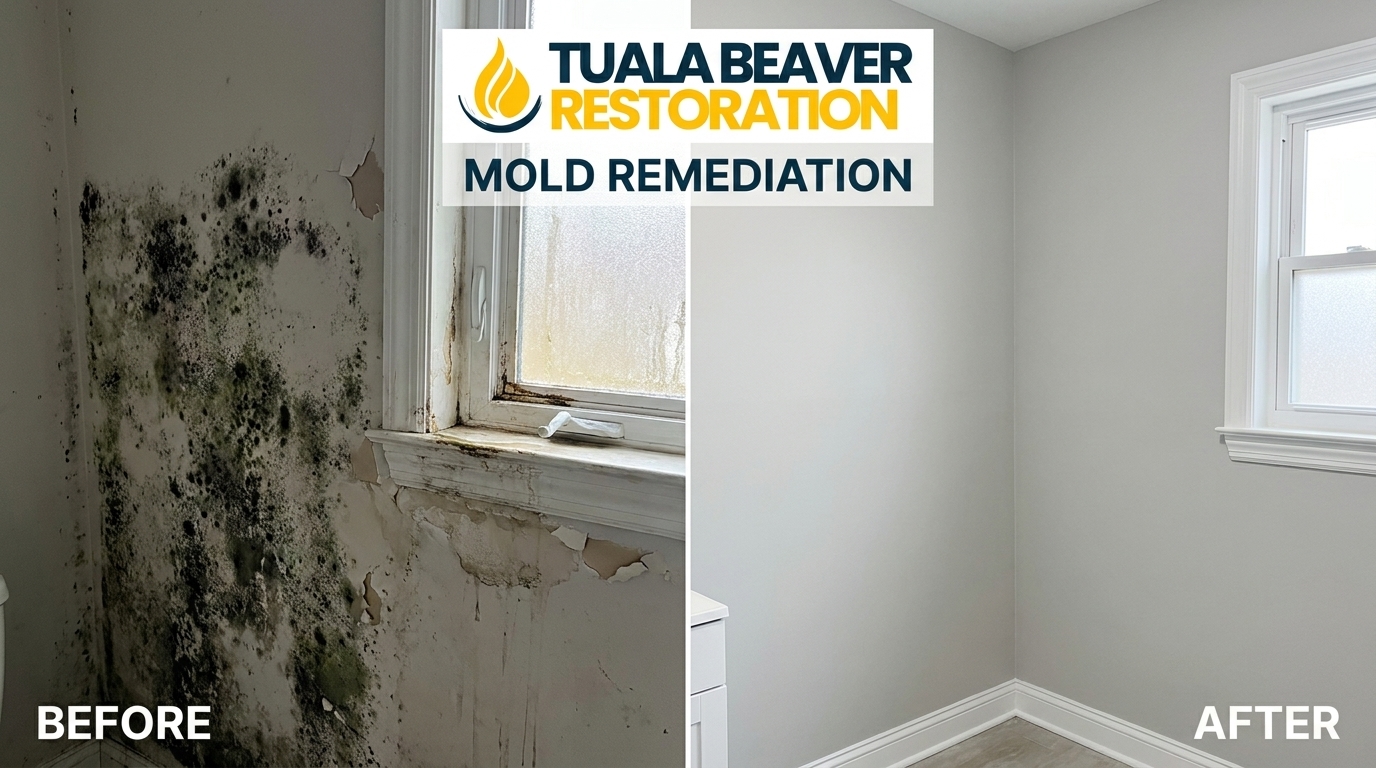
A Cedar Hills 1986-era crawl space with years of accumulated mold on floor joists and subfloor sheathing fully remediated, vapor barrier replaced, and crawl space ventilation upgraded — no recurrence after two Oregon rainy seasons
A Raleigh West attic mold event traced to a bathroom exhaust fan vented into the attic space, remediated and rerouted to exterior to prevent recurrence
A South Beaverton water damage event from a burst pipe correctly assessed as including mold within 24 hours of initial water contact in Beaverton's marine-zone conditions
A Five Oaks commercial property's multi-unit mold event remediated using CDS-certified large-scale equipment alongside AMRT protocol, with documented clearance for building management
Mold Remediation Equipment and Methods in Beaverton, OR
ANSI/IICRC S520-compliant equipment for Beaverton's marine-zone conditions
Mold Removal vs. Mold Remediation in Beaverton, OR: Why the Difference Matters More Here Than Anywhere
Surface mold treatment fails faster in Beaverton's climate than anywhere else
"Mold removal" addresses only visible mold growth on surfaces. "Mold remediation" follows the ANSI/IICRC S520 Standard — correcting the moisture source, removing affected materials, treating the environment, and verifying clearance. In Beaverton's marine-zone climate, the failure rate of surface-only mold treatment is exceptionally high: clay soils continue providing moisture to foundations, ambient humidity maintains conditions favorable to mold growth, and the original moisture driver — usually a vapor barrier failure or ventilation shortfall in a 1986-era home — continues working against you.
| Approach | What It Does | What It Misses |
|---|---|---|
| Surface Mold Cleaning | Removes visible surface mold | Moisture source, hidden mold in cavities, spore baseline — all continue in Beaverton's climate |
| ANSI/IICRC S520 Remediation (Tuala Beaver) | Full protocol: source correction, removal, air treatment, clearance verification | Nothing — remediation is complete to documented standard |
Why Surface Treatment Fails Faster in Beaverton
Estimate Your Mold Remediation Cost in Beaverton, OR
From a contained surface problem to major crawl space or commercial remediation
We provide a free mold inspection and assessment with transparent, documented pricing before any work begins.
Main Cost Drivers
| Remediation Scope | Typical Range |
|---|---|
| Surface mold (bathroom, under sink) | ~$500 – $2,000 |
| Crawl space mold remediation | ~$250 – $6,000+ |
| Attic mold remediation | ~$1,000 – $7,000 |
| Post-water-damage mold (wall/floor) | ~$1,000 – $20,000 |
| Commercial mold (CDS scope) | Custom assessment |
| Mold testing / air quality assessment | ~$250 – $350 |
Note: National average for mold remediation is approximately $2,000; Beaverton projects reflect Pacific Northwest market conditions.
Who Needs Professional Mold Remediation in Beaverton, OR?
When AMRT-certified remediation is the only approach that works in Beaverton's climate
Benefits of Certified Mold Remediation in Beaverton, OR
AMRT certification and ANSI/IICRC S520 compliance protect your property in Beaverton's specific conditions
S520-compliant remediation corrects the moisture source, preventing recurrence in Beaverton's clay-soil, marine-zone conditions
Negative-pressure containment prevents Beaverton's ambient air from spreading spores during active removal
Post-remediation clearance testing is the only reliable confirmation — essential for Oregon seller disclosures and insurance claims
CDS certification enables commercial large-loss mold scope that most residential AMRT companies in Beaverton cannot handle
Moisture source correction specific to 1986-era Beaverton construction prevents annual recurrence in aging vapor barrier and ventilation systems
Safety Alert: Do Not Disturb Mold Without Negative-Pressure Containment — Especially in Beaverton's Marine-Zone Air
Disturbing mold without containment in Beaverton's ambient humidity spreads it faster than in drier climates
Beaverton's marine-zone ambient air maintains near-mold-growth humidity levels year-round. When mold colonies are disturbed without proper negative-pressure containment, released spores distribute into air that readily supports their recolonization on previously unaffected surfaces. This is more consequential in Beaverton than in drier climates — the same spore release event that might self-resolve in a dry Colorado home will almost certainly establish new colonies in Beaverton's conditions.
Mold Remediation FAQs for Beaverton, OR Property Owners
Answers about cost, Beaverton's specific mold risk, crawl spaces, and Oregon seller disclosures
Crawl space mold remediation in Beaverton typically runs $250 to $6,000 depending on extent and access. Attic mold costs $1,000 to $7,000. Post-water-damage wall mold can range $1,000 to $20,000 or more. The national average is approximately $2,000 for a medium project. We provide a free assessment before any work begins.
Three factors compound in Beaverton more than almost anywhere else: clay soils that retain moisture against foundations long after rain ends, a significant housing stock built around 1986 with aging vapor barriers and ventilation, and a marine-zone climate where ambient outdoor air provides no drying assistance to wet building materials.
In Beaverton's Pacific Northwest climate, the ambient conditions do not allow materials to dry on their own within the mold-growth window. Any water damage not professionally addressed within 24 hours should be assumed to involve mold development. For immediate response, contact our emergency water damage restoration team.
Yes. Oregon's seller disclosure laws require disclosure of known mold and water damage. Documented post-remediation clearance testing from an AMRT-certified contractor provides the verification needed to demonstrate that a previously known mold issue has been professionally and completely addressed.
Our Beaverton Mold Remediation Guarantee
AMRT-certified remediation that corrects the source and works in Beaverton's specific climate conditions
Tuala Beaver Restoration stands behind every mold remediation project in Beaverton, OR with IICRC AMRT-certified protocol, ANSI/IICRC S520 compliance, and our own satisfaction guarantee. When we remediate mold in your Beaverton home or business, we correct the moisture source that allowed it to grow in this marine-zone climate — so the same location doesn't require retreatment when Oregon's next rainy season arrives.
Since 2015, property owners across Beaverton — from 1986-era crawl-space homes in Cedar Hills and Highland to commercial properties near Nike World Headquarters and the Tanasbourne corridor — have trusted Tuala Beaver Restoration for mold remediation in Beaverton, OR that genuinely improves their indoor air quality and holds up through the Pacific Northwest's relentless rainy seasons.
Request a callback online · View all services · See all service areas
Get Professional Mold Remediation in Beaverton OR Now
Need an AMRT-certified mold remediation company in Beaverton OR? Our 30 skilled professionals are standing by. If you can't find the information you need about our restoration services in Beaverton OR, please reach out and we'll walk you through your options.
Contact Tuala Beaver Restoration
(971) 518-4200
tualabeaverrestoration@gmail.com
4715 SW Murray Blvd
Beaverton, OR 97005
24/7 Emergency Service Available
Mold Remediation — Service Area Coverage
When planning restoration services in Beaverton, our mold remediation team accounts for Tualatin Valley soil and moisture conditions near Tualatin, urban construction patterns near Portland, suburban housing stock throughout Hillsboro, and 1986-era construction challenges throughout Washington County.