Basement Flood Cleanup in Beaverton, OR — Below-Grade Water Removal for the Tualatin Valley
24/7 Flooded Basement & Crawl Space Response — Serving Beaverton, Washington County & the Portland Metro Since 2015
When your basement or crawl space floods from a sump pump failure, Tualatin River-area high water table, Oregon wet season storm, or burst pipe, Tuala Beaver Restoration provides fast, IICRC-certified basement flood cleanup in Beaverton, Oregon. Our 30-person team deploys 24/7 with submersible pumps, crawl space dehumidifiers, and below-grade drying equipment designed for the confined, soil-adjacent environments where Beaverton's volcanic clay soils trap moisture long after the storm ends. Need emergency water damage restoration for above-grade flooding emergencies as well? We handle both. When flooding causes structural damage, we also provide water damage repair for structural reconstruction after basement flooding.
Call (971) 518-4200 — 24/7 Flooded Basement EmergencyNo Extra Charge to Call — Free On-Site Assessment
- Local Beaverton, OR basement flood cleanup company since 2015
- IICRC-certified technicians: WRT, ASD, and AMRT for below-grade drying
- CDS certification for commercial below-grade and large-loss flood cleanup
- 24/7 emergency response for sump pump failure, groundwater intrusion, and storm flooding
- Serving Aloha, Cedar Hills, Hillsboro, Tigard, Tualatin, and Washington County
Request Emergency Basement Flood Cleanup
Fill out the form and we'll contact you immediately!
Award-Winning Flooded Basement Cleanup in Beaverton, Oregon
Washington County's IICRC-certified below-grade flood response team
Tuala Beaver Restoration is a fully certified basement flood cleanup company with 10 years of experience responding to below-grade flooding throughout Beaverton and Washington County's Tualatin Valley. Led by Owner Bill Olson, our team holds five IICRC certifications — including the Commercial Drying Specialist (CDS) credential for large-scale below-grade commercial flood events beyond the scope of standard residential restoration teams. If mold has developed in your basement or crawl space, our mold remediation if mold has developed in your basement or crawl space service addresses post-flood microbial growth with AMRT-certified technicians.
WRT
Water Damage Restoration Technician — IICRC Certified
ASD
Applied Structural Drying — IICRC Certified
AMRT
Applied Microbial Remediation Technician — IICRC Certified
CDS
Commercial Drying Specialist — IICRC Certified
FSRT
Fire & Smoke Damage Restoration Technician — IICRC Certified
Basement Flood Cleanup for Properties Near Beaverton's Parks, Trails & Neighborhoods
From Central Beaverton and South Beaverton to Fanno Creek, Sexton Mountain, and the Tualatin Valley corridor
Tuala Beaver Restoration responds to basement and crawl space flooding throughout Beaverton, Oregon — from older properties in Central Beaverton and Cedar Hills near Fanno Creek Greenway where high water tables and clay soils create persistent below-grade moisture risk, to split-level and lower-level spaces in South Beaverton and West Slope, to commercial properties near Nike World Headquarters, Progress Ridge TownSquare, and the Five Oaks and Tanasbourne corridors. Beaverton's position on the Tualatin Valley floor means wet-season rainfall raises the regional groundwater table and overwhelms storm drainage across the city — and homes with crawl spaces across Washington County are particularly vulnerable as water migrates through foundation walls during extended Oregon rain events. We are serving Aloha, Cedar Hills, Hillsboro, Tigard, Tualatin, and Washington County with the full resources of a 30-person team.
Beaverton Neighborhoods Served
- Central Beaverton
- Denney Whitford / Raleigh West
- Five Oaks / Triple Creek
- Greenway
- Highland
- Neighbors Southwest
- Sexton Mountain
- South Beaverton
- Vose
- West Beaverton
- West Slope
Parks & Greenways
- Tualatin Hills Nature Park
- Fanno Creek Trail
- Cooper Mountain Nature Park
- Hyland Forest Park
- Cedar Hills Park
- Hidden Creek Park
Commercial Landmarks
- Nike World Headquarters
- Patricia Reser Center for the Arts
- Progress Ridge TownSquare
- Cedar Hills Crossing
- The Round at Beaverton Central
Beaverton's Below-Grade Flood Cleanup Specialists — Crawl Space and Basement Equipment Built for Tualatin Valley Conditions
Below-grade drying in Beaverton requires specialized equipment and protocols — not above-grade methods applied below ground
Basement and crawl space flood cleanup is technically distinct from above-grade water damage restoration in ways that directly affect outcome. Beaverton's volcanic clay soils retain moisture near foundation walls long after standing water is removed, making thorough below-grade drying harder and longer than in regions with faster-draining soils. Our team deploys crawl space dehumidifiers, confined-space air movers, and daily calibrated moisture monitoring specifically designed for the below-grade environments common throughout the Tualatin Valley. For properties with combined fire and water damage, we also provide fire damage restoration for properties with combined fire and water damage.
- Below-grade-specific equipment: crawl space dehumidifiers and confined-space air movers designed for Beaverton's soil-adjacent conditions
- Submersible pumps and truck-mounted extractors for high-volume basement and crawl space water removal
- Vapor barrier assessment and temporary moisture barrier installation where needed during extended drying
- CDS certification enables commercial below-grade flood cleanup beyond residential restoration scale
- Complete insurance documentation: photos, moisture readings, and scope reports from first response through clearance
When Do Beaverton Homeowners Need Basement Flood Cleanup?
The most common below-grade flooding causes in Washington County
Beaverton's geographic position on the Tualatin Valley floor and its volcanic clay soil profile create specific, well-documented below-grade flooding risks throughout Oregon's wet season. Understanding the cause helps determine the right cleanup approach and any prevention steps to consider after drying is complete.
Sump Pump Failure
Failure during an Oregon wet season storm allows groundwater to rise above the pump pit and flood the basement or crawl space.
High Water Table
Low-lying Beaverton neighborhoods near the Tualatin River experience overwhelming drainage during extended rain events.
Groundwater Intrusion
Moisture pushes through foundation cracks or porous block walls in older Central Beaverton and Cedar Hills properties.
Burst Below-Grade Pipes
Water heaters, utility connections, or in-floor supply lines burst in below-grade plumbing areas.
Sewage Backup
Root-clogged sewer laterals or Beaverton's aging sewer infrastructure backs up into basement drains — a confirmed local issue.
Hillside Drainage Failure
Sexton Mountain hillside drainage failures redirect stormwater runoff into foundation areas during Oregon's October–May wet season.
Who Our Basement Flood Cleanup Service Is For
Homeowners, landlords, commercial property managers, and businesses throughout Washington County
We provide basement flood cleanup for single-family homes, rental properties, multi-unit residential buildings, and commercial properties throughout Beaverton and all of Washington County.
Homeowners in South Beaverton, West Slope, and Central Beaverton neighborhoods whose basements flood during Oregon wet season storms
Owners of older Cedar Hills and Raleigh Hills homes with crawl space foundations and aging vapor barriers
Landlords and property managers responsible for below-grade rental units during flooding events
Commercial property owners near Five Oaks, Tanasbourne, and the Nike HQ corridor with flooded lower-level spaces
Homeowners whose sump pump failed overnight during a storm and flooded the basement before discovery
Anyone dealing with a sewage backup in a basement or below-grade bathroom
Tualatin Valley Soils, Seasonal Rain & Basement Flooding Risk in Beaverton, OR
How Washington County's geography and soil profile create year-round below-grade challenges
Beaverton sits on the floor of the Tualatin Valley, where volcanic clay soils retain water near foundation walls much longer than well-draining soils. When Oregon's wet season delivers extended rainfall — typically October through May — the regional groundwater table rises, storm drainage systems become overwhelmed, and homes with crawl space or basement construction face genuine below-grade intrusion risk. Unlike sandy soils that allow water to percolate away from foundations, Beaverton's clay-dominant soil profile holds moisture against foundations for days or weeks after a storm ends, creating sustained below-grade pressure that sump pumps and drainage systems must continuously manage.
- Beaverton's volcanic clay soils retain moisture near foundation walls significantly longer than faster-draining soils, sustaining below-grade pressure after storms
- Low-lying Beaverton neighborhoods near the Tualatin River and Fanno Creek have a high seasonal water table that raises during Oregon's October–May wet season
- Older Beaverton properties in Cedar Hills and Raleigh West were often built before modern crawl space waterproofing standards, leaving below-grade spaces vulnerable during extended rain events
- Hillside drainage failures near Sexton Mountain can redirect stormwater runoff into foundation areas during heavy Oregon wet season rain events
Peak Wet Season
October – May
8 months of sustained rainfall that raises Beaverton's regional groundwater table
Soil Type
Volcanic Clay
Retains moisture against foundations for days or weeks after storm events end
Valley Floor Position
Tualatin Valley
Low elevation receives drainage from surrounding hills including Sexton Mountain
Sump Pump Failure, Groundwater Intrusion & Storm Flooding: Below-Grade Water Types in Beaverton, OR
Understanding your Beaverton flooding type determines the right cleanup protocol
For basement flood cleanup in Beaverton, the flooding source directly determines cleanup protocols, required equipment, and any contamination or decontamination requirements.
| Flooding Type | Source | Cleanup Protocol |
|---|---|---|
| Sump Pump Failure | Groundwater rises above pump pit during failure | Submersible extraction, below-grade drying, pump assessment |
| Groundwater Seepage | Tualatin Valley clay soils pushing moisture through foundation cracks | Extraction, thorough below-grade drying, vapor barrier assessment |
| Surface / Storm Flooding | Oregon wet season stormwater entering below grade | Extraction, drying, contamination category assessment |
| Burst Pipe (Below Grade) | Water heater, utility connection, or in-floor supply line | Extraction, structural drying, source repair coordination |
| Sewage Backup | Aged sewer laterals or Beaverton infrastructure backup | Category 3 decontamination, extraction, full sanitization |
| Commercial Below-Grade Flood | Lower-level commercial space in multi-story Beaverton property | CDS-certified large-loss drying system deployment |
Groundwater intrusion via Beaverton's clay soils is one of the most common and persistent below-grade issues — clay retains water against foundations for weeks, requiring extended drying times compared to sandy-soil regions
Sewage backup from root-clogged or aged Beaverton sewer lines is a confirmed local issue and a genuine health hazard requiring full Category 3 decontamination regardless of apparent scope
Commercial below-grade flooding in Beaverton's Five Oaks and Tanasbourne corridors may require CDS-certified large-loss equipment deployment beyond what residential restoration teams can execute
Oregon wet season stormwater that has traveled through Beaverton's clay soils before entering a basement may carry contaminants, elevating it above Category 1 clean water
Our 6-Step Basement Flood Cleanup Process in Beaverton, OR
From standing water to IICRC-verified dry clearance
Emergency Dispatch & Flooding Assessment
We respond immediately, assess the flooding source and water category, and deploy the right extraction and safety equipment for your specific Beaverton below-grade situation.
Standing Water Extraction
We deploy submersible pumps and truck-mounted extractors to remove all standing water from the basement or crawl space, including from behind vapor barriers and under stored items.
Content Protection & Documentation
We document, protect, and relocate salvageable contents from the flooded area, separating materials that can be restored from those that cannot.
Below-Grade Structural Drying
We install crawl space-specific dehumidifiers and confined-space air movers calibrated for Beaverton's clay-soil moisture conditions, monitoring daily with calibrated moisture meters to track verified drying progress.
Contamination Control & Antimicrobial Treatment
For groundwater, stormwater, or sewage-adjacent events, our AMRT-certified technicians apply EPA-registered antimicrobial treatment to all affected surfaces and document scope and application for insurance records.
Final Moisture Verification & Insurance Documentation
We perform a final IICRC dry standard moisture verification and deliver complete documentation — photos, moisture logs, and scope reports — to support your insurance claim.
What's Included in Our Beaverton Basement Flood Cleanup Service
From standing water through verified dry clearance
Beaverton's Trusted Basement Flood Cleanup Team
Local knowledge, below-grade-specific equipment, and five IICRC certifications
When you compare basement flood cleanup companies in Beaverton, Tuala Beaver Restoration stands out for genuine below-grade-specific equipment, local Tualatin Valley flooding knowledge, and the CDS certification that enables commercial below-grade flood cleanup beyond residential scale.
10 Years in Beaverton
Serving Beaverton, OR and all of Washington County since 2015
5 IICRC Certifications
WRT, ASD, AMRT, CDS, and FSRT — full spectrum of restoration credentials
30 In-House Professionals
No subcontractors — 30 trained technicians with 5 fully equipped service vehicles
Direct Dispatch 24/7
No call center — direct emergency dispatch from our Beaverton team
Insurance Documentation
Complete documentation support from first call through clearance for a smooth claims process
What Fast Below-Grade Response Prevents in Beaverton, OR
Real outcomes from rapid below-grade response in the Tualatin Valley
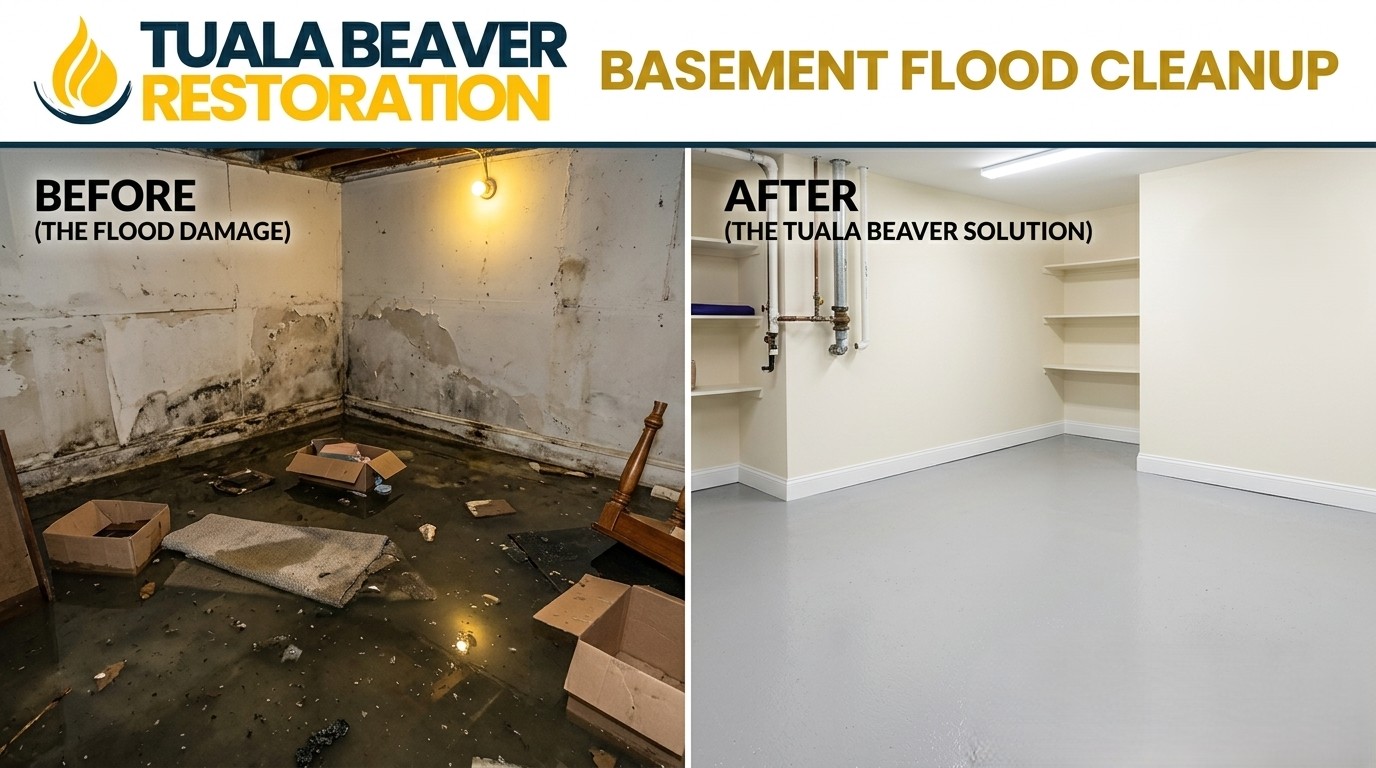
- A South Beaverton home's crawl space flooded during an Oregon wet season storm, extracted and dried to IICRC dry standard as Beaverton's clay soils continued driving moisture against the foundation
- A Central Beaverton sump pump failure discovered overnight restored before structural materials absorbed significant moisture
- A Five Oaks commercial lower-level storage space dried using CDS-certified protocol after a building pipe burst flooded the below-grade area
- A Cedar Hills older home's groundwater seepage through original foundation walls addressed with thorough below-grade drying and vapor barrier assessment
Basement Flood Cleanup Equipment and Methods in Beaverton, OR
Below-grade-specific equipment for Tualatin Valley's clay-soil conditions
Submersible Pumps
Rated for high-volume, continuous below-grade water removal from basements and crawl spaces
Truck-Mounted Extractors
Rapid standing water removal in accessible below-grade spaces with industrial-grade suction
Crawl Space Dehumidifiers
Designed for confined, low-clearance Pacific Northwest environments with persistent soil moisture
Confined-Space Air Movers
Configured for below-grade airflow in Beaverton's soil-adjacent drying conditions
Thermal Imaging Cameras
Moisture detection behind foundation walls and under subfloor systems invisible to visual inspection
Antimicrobial Treatments
EPA-registered antimicrobial treatments and fogging equipment for contamination control
Basement Flood Cleanup vs. Waterproofing in Beaverton: What Each Solves
Cleanup handles the current event; waterproofing prevents the next one
Basement flood cleanup is an emergency response — it removes water that has already entered your space, dries the structure to verified standard, and prevents mold from the current event. Basement waterproofing — interior drainage systems, sump pump installation or replacement, and vapor barrier encapsulation — prevents future events. In Beaverton's clay-soil environment, waterproofing is a meaningful investment for homes in low-lying Washington County neighborhoods near the Tualatin River, but it should only happen after certified dry clearance.
| Service | What It Addresses | When You Need It |
|---|---|---|
| Basement Flood Cleanup (Tuala Beaver) | Current flooding: extraction, drying, mold prevention | Right now, when flooding has already occurred |
| Basement Waterproofing | Future flooding prevention: drainage, sump pump, vapor barrier | After cleanup and certified dry clearance |
Flood cleanup always precedes waterproofing — waterproofing into a wet or incompletely dried space traps moisture against framing and foundation materials
After IICRC dry clearance, waterproofing investments make particular sense for Beaverton properties on clay-soil terrain near the Tualatin River or Fanno Creek watershed
Our cleanup documentation notes drainage patterns and intrusion points during extraction — useful information for any subsequent waterproofing scope
Estimate Your Basement Flood Cleanup Cost in Beaverton, OR
From a sump pump failure to major stormwater flooding with contamination
We provide a free on-site assessment with transparent, documented pricing before any work begins.
Main Cost Drivers
- Flooding source and water category (clean, gray, or sewage contamination)
- Total below-grade area in square feet
- Duration of water exposure before professional response — extended times in Beaverton's clay-soil conditions increase drying time and cost
- Whether finished materials need removal or drying
- Whether commercial CDS scope is required for large below-grade events
| Cleanup Scope | Typical Range |
|---|---|
| Standard crawl space or sump pit overflow | ~$1,500 – $3,000 |
| Standard 500 sq ft basement, clean water | ~$1,500 – $3,000 |
| Multi-area basement flooding | ~$3,500 – $8,000 |
| Category 3 sewage backup in below-grade space | ~$5,000 – $15,000+ |
| Commercial below-grade flood (CDS scope) | Custom assessment |
Local data: The average flood cleanup cost in Beaverton is $3,487–$3,762 based on 17 completed local projects.
Who Needs Professional Basement Flood Cleanup in Beaverton, OR?
When standing water in your below-grade space requires immediate professional response
Your sump pump has failed and standing water is present in the basement or crawl space
Your crawl space has flooded during or after an Oregon wet season storm event
Groundwater has seeped through foundation cracks in a low-lying Beaverton neighborhood
A pipe has burst in a below-grade utility area, water heater closet, or crawl space
A sewage backup has affected your basement drain or toilet
Your commercial property near Five Oaks or Tanasbourne has a flooded lower-level space
Benefits of Certified Basement Flood Cleanup in Beaverton, OR
Below-grade spaces dry differently in Beaverton's clay-soil environment
Beaverton's volcanic clay soils create a uniquely challenging below-grade drying environment — moisture doesn't just evaporate, it continues migrating inward from clay-saturated soil long after standing water is removed. Consumer fans and dehumidifiers cannot address this sustained inward moisture migration. Professional below-grade equipment and daily calibrated moisture monitoring are necessary to confirm genuine dryness in Beaverton's Tualatin Valley conditions. Our mold remediation if mold has developed in your basement or crawl space service is available if post-flood mold growth has already begun.
Specialized Below-Grade Drying
Crawl space-specific dehumidifiers and confined-space air movers are required for effective below-grade drying in Beaverton's clay-soil conditions
IICRC Dry Standard Verification
The only reliable confirmation that a below-grade space has genuinely dried despite ongoing soil moisture migration
Early Mold Prevention
Early mold prevention during cleanup is far less expensive than post-mold remediation in a confined space
Insurance Documentation
Complete insurance documentation from a certified company supports a smoother claim process
Foundation & Structural Protection
Professional response protects foundation materials, subfloor systems, and framing from degradation that unchecked soil moisture causes
Safety Alert: Flooded Basements & Crawl Spaces Have Specific Safety Hazards
Below-grade flooding in Beaverton is not a DIY cleanup situation in most cases
Flooded below-grade spaces combine genuine safety hazards: electrical shock risk from outlets, panels, or water heaters in contact with water; contamination risk from sewage or groundwater carrying pathogens; and oxygen depletion risk in confined crawl spaces where organic decomposition has begun. In Beaverton, stormwater and groundwater that has traveled through clay soils may carry agricultural or chemical contaminants from upstream watershed areas.
Electrical Hazard
Never enter a flooded basement where water may contact electrical panels, outlets, or water heaters — shut off power at the main breaker first if safe to reach
Oxygen Depletion Risk
Crawl spaces after flooding may have reduced oxygen levels from organic decomposition — do not enter without safety assessment
Contamination Risk
Beaverton groundwater and stormwater that has traveled through volcanic clay soils may carry contaminants — treat any natural drainage flood as potentially contaminated
Moisture Verification
Do not verify a below-grade space as dry based on visual inspection alone — calibrated moisture meters are required for accurate assessment in clay-soil conditions
Basement Flood Cleanup FAQs for Beaverton, OR Property Owners
Answers about cost, response time, sump pumps, and what to do before crews arrive
Based on 17 completed local projects, the average flood cleanup cost in Beaverton runs $3,487–$3,762. A standard 500-square-foot basement with clean water typically costs $1,500–$3,000 to extract and dry. Sewage or black water events can double or triple that figure due to the contamination protocols required.
Beaverton's volcanic clay soils retain water near foundation walls much longer than sandy soils, and low-lying neighborhoods near the Tualatin River face a high seasonal water table during Oregon's October–May wet season. Homes with undersized or aging sump pumps, or inadequate vapor barriers in crawl spaces, are most vulnerable during extended rain events.
Sudden pump failure causing water damage is often covered under standard Oregon homeowner's policies. Flooding from rising groundwater typically requires a separate flood insurance policy through the NFIP. We document the event thoroughly and work directly with your adjuster regardless of coverage type.
A small crawl space event with limited standing water typically takes 3 to 5 days to reach IICRC dry standard. A larger flooded basement may take 5 to 10 days. Beaverton's clay-soil conditions often require extended drying time compared to faster-draining regions. Contamination events may take longer.
Our Beaverton Basement Flood Cleanup Guarantee
Certified below-grade response, complete documentation, and genuinely dry clearance
Tuala Beaver Restoration stands behind every basement flood cleanup project in Beaverton, OR with IICRC-certified technique, below-grade-specific equipment, and our own satisfaction guarantee. When you call us about a flooded basement or crawl space, we respond immediately, extract completely, dry to IICRC verified standard accounting for Beaverton's clay-soil conditions, and document everything your insurance company needs.
Since 2015, property owners across Beaverton — from crawl-space homes in Central Beaverton and Cedar Hills to commercial lower-level spaces near the Five Oaks and Tanasbourne corridors — have trusted Tuala Beaver Restoration for dependable basement flood cleanup when Washington County's wet season storms put their properties at risk. We also provide emergency water damage restoration for above-grade flooding emergencies and water damage repair for structural reconstruction after basement flooding to fully restore your property.
Call (971) 518-4200 — 24/7 Basement Flood Cleanup in BeavertonBasement Flood Cleanup Service Area — Beaverton, OR & Washington County
Our emergency basement flood cleanup team serves all of these communities 24/7
Get Emergency Basement Flood Cleanup in Beaverton OR Now
Need a restoration company in Beaverton OR? Our 30 skilled professionals are standing by 24/7 for basement and crawl space flooding.
Contact Tuala Beaver Restoration
(971) 518-4200
tualabeaverrestoration@gmail.com
4715 SW Murray Blvd
Beaverton, OR 97005
24/7 Emergency Service Available